

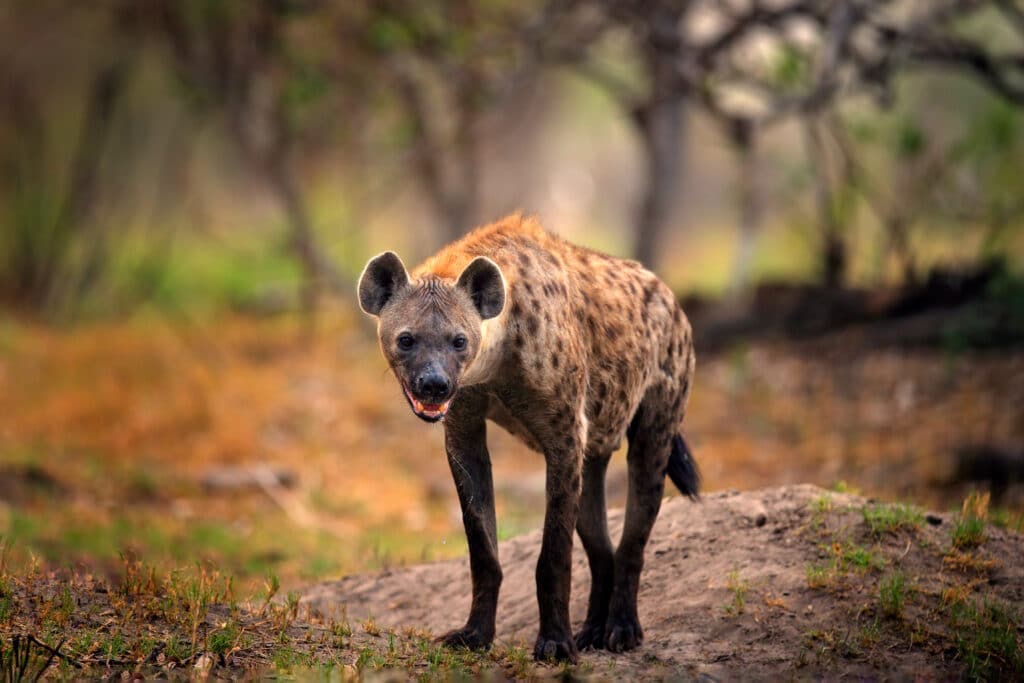
A COMMON SOUND AT KUBE YINI
Nocturnal Laughter
Kube Yini
The African spotted hyena (Crocuta crocuta) is one of the most fascinating and misunderstood carnivores in the animal kingdom. Widely distributed across sub-Saharan Africa, these resilient and adaptable animals thrive in a range of environments, from savannas and grasslands to forests and mountainous regions. Despite their often-negative portrayal in popular culture, spotted hyenas play a critical role in maintaining the health and balance of their ecosystems.
Spotted hyenas are the largest of the hyena species, with adults weighing between 40 to 86 kg and measuring 95 to 165 cm in body length, excluding their bushy tails, which add another 25 to 30 cm. They have a robust, bear-like build, with a sloping back and powerful jaws capable of exerting a bite force of up to 1,100 psi, making them one of the most formidable predators in Africa. Their coat is coarse and short, typically a sandy, yellowish-brown color with distinct dark spots scattered across their bodies, which provide excellent camouflage in their natural habitats.
One of the most distinctive features of the spotted hyena is its complex social structure. These animals live in matriarchal clans that can number up to 80 individuals, with females being larger and more dominant than males. The social hierarchy within a clan is strictly enforced, with the highest-ranking females and their offspring enjoying priority access to food and resources. This social system is one of the most intricate among mammals and is thought to be a key factor in the hyena’s evolutionary success.
Spotted hyenas are versatile feeders with a diet that includes a wide variety of prey, from wildebeest and zebras to smaller mammals, birds, and reptiles. They are both proficient hunters and scavengers, capable of taking down prey as large as adult antelopes, but also adept at stealing kills from other predators like lions and leopards. Their powerful jaws and digestive systems allow them to consume almost every part of their prey, including bones, hooves, and hides, which helps keep their environment clean by disposing of carrion.
Reproduction in spotted hyenas is unique and complex. Females have an unusually long gestation period of about 110 days, and they give birth to one to four cubs in a secluded den. Hyena cubs are born with their eyes open and teeth erupted, allowing them to be relatively active shortly after birth. Sibling rivalry is intense, often leading to the death of weaker cubs in a phenomenon known as siblicide. Cubs remain in the den for the first few weeks of life, after which they begin to explore and integrate into the clan’s social structure.
Despite their ecological importance, spotted hyenas face numerous threats, primarily from human activities. Habitat loss due to agricultural expansion, human-wildlife conflict, and persecution have led to declines in hyena populations in some regions. In addition, misconceptions and negative attitudes toward hyenas often result in their being killed or driven away from their natural habitats.
Conservation efforts are crucial to ensuring the survival of spotted hyenas and the maintenance of the ecological balance they help sustain. Protecting their habitats, reducing human-wildlife conflict through community engagement and education, and promoting positive perceptions of hyenas are essential strategies for their conservation. Research and monitoring programs also play a vital role in understanding hyena behavior and ecology, which can inform effective management and conservation practices.
In conclusion, the African spotted hyena is a remarkable species with unique adaptations and social structures that allow it to thrive in diverse environments. By recognizing their ecological importance and working to mitigate threats, we can ensure that these extraordinary animals continue to play their vital role in Africa’s ecosystems. The spotted hyena’s story is one of resilience and complexity, deserving of admiration and protection as an integral part of the natural world.
