

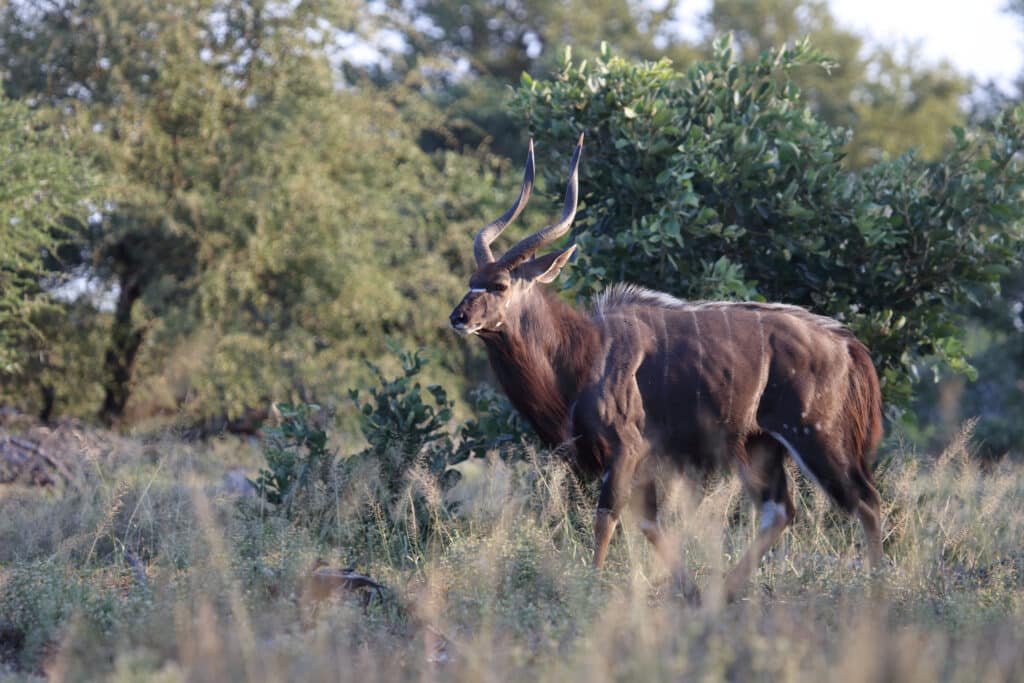
The Nyala Management Plan research paper.
Applying K to Kube Yini
Dr R Schramm | KY45
The in-depth research paper Nyala –A management plan compiled by JR Van Rensberg on behalf of Mun- Ya-Wana has kindly been made available to Kube Yini, the study significant not only for its ecological value, but also for the economic benefits implementation of its models can bring to our Mountain Wilderness- Kube Yini.
Data collected during a protocolized and fixed study period between 2013 and 2014 has resulted in a far-reaching management plan, applicable also to us as next-door neighbour and part of the nyala habitat heartland. Historical accounts of nyala first sighted as inhabiting the Northern Shores of St Lucia remain true even today, with 78% of all nyala in South Africa still concentrated in KZN.
Although known to consume an average of 3.5 litres of water per day, nyala are not considered water depended, being able to persist for months in the absence of surface water and making them an ideal species in an area such as ours suffering from annually decreasing rainfall – with the caveat that adequate browsing vegetation for a given population density is maintained. The very pertinent observation is therefore made that with management interventions negatively correlating to the size of the managed area. Smaller reserves require an increased level of compensational management not only to maintain genetic diversity, but also to preserve the ecological carrying capacity (K) of the reserve. In this regard, vegetation surveys must be considered crucial in creating the equilibrium necessary to retain the iconic sight of nyala on Kube Yini, sustain the predators (leopard and hyena) present on Kube Yini, and advance the economic benefits arising from live sales.
Of interest to note here is that unlike lion who predate mostly on male nyala, leopard do so predominantly on female nyala, and do so in marked preference to even sub-adults and juveniles. Assessment of adult nyala removed during live take-off is consequently important to maintain the sex-ratio, as it also is to prevent biased male selection based on horn conformation. Veld management was therefore found to be pivotal when establishing carrying capacity and creating equilibrium between various species and the reserves vegetation.
The intended outcome of more intensive management is to bring about the ability to harvest the population when it reaches maximum growth rate, this giving the largest yield continuously over an infinite period (the MSY concept). The concept allows prediction of deteriorating environmental conditions and when subsequent high intensity harvest is required, aiming to reduce the population back to a state of equilibrium with the pending ecologically unfavourable conditions. Updated vegetation maps to calculate carrying capacity and MSY are on this basis recommended to take place every five years and should be seen as a priority above any other current vegetation related studies. In the case of Mun-Ya-Wana, this model established that the reserve was in fact largely under-stocked with nyala when based on its current vegetation cycle.
In depth analysis of the various population census techniques show that our current practice of waterhole census remains the only viable option to Kube Yini, local terrain for example making accurate transects difficult, modalities like aerial surveys cost ineffective, and drive-by observations when conducted by non-professionals unreliable. Nyala however drink only once daily and census observation hours have to take factors such as peak predation time and peak human presence into account. Nyala were found to adjust their daily drinking pattern to the period of minimal interference in any given area or waterhole.
Calculations in the report have all been derived from extensive research and meticulously collected data laid open to scientific scrutiny. The researcher acknowledges that the proposed models may not be perfect, but that ongoing diligence and field testing will hone them over the coming years to negate any such discrepancies as may yet to come to light.
If you would like a copy of this paper, please get in touch with the office.
This article was taken from Leopards Call Number 97- Kube Yini- April 2021
